
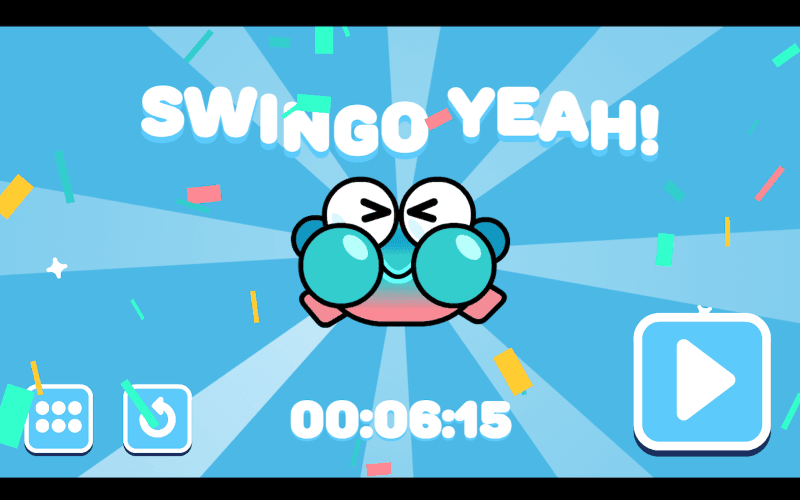
Swingo is a physics based grappling hook game where you swing and bounce through levels by aiming and firing your hook at surfaces.
It starts easy but quickly becomes a timing challenge because every hook changes your angle and speed.
It is addictive because levels are short, restarts are fast, and smooth rhythm based swings feel rewarding.
Swingo teaches the same skill as A Small World Cup: calm timing and smart positioning instead of panic.
Practice early hooks and early releases, then repeat key swings until they feel automatic.
Swingo is a physics driven arcade platform game where your character moves using a grappling hook style rope. Instead of running or jumping in the usual way, you aim your hook at surfaces, pull yourself forward, and use bounce and swing momentum to reach the goal.
The game feels simple at first, but it quickly becomes a timing challenge. Every shot changes your angle, speed, and landing point.
The best runs look smooth and controlled, while rushed inputs usually send you into walls, spikes, or awkward rebounds.
Swingo works well for short play sessions because levels are compact, restarts are fast, and improvement is easy to measure. You can feel yourself getting better almost immediately once your swings become more intentional.
Swingo is built around one satisfying loop: read the room, shoot the hook, ride the momentum, then stick the landing. Each level is like a small puzzle that rewards rhythm more than brute speed.
Three things keep players coming back.
First, the movement is expressive. Even with simple controls, you can create your own line through a level.
Second, the difficulty ramps in a fair way. Early stages teach basics, later stages demand precision.
Third, the unlocks and progression give you a reason to keep clearing levels, even when a tricky section slows you down.
Most versions of Swingo use simple aim and hook controls.
The key is to stop thinking of each hook as a single move. Treat it like a chain. One clean swing sets up the next swing. One bad angle forces a messy recovery.
Hook earlier than you think, then release sooner than you want.
Many beginners wait until they are close to danger before firing. That usually creates panic angles and heavy rebounds.
When you hook earlier, you get more time to shape the arc and land with control.
Choose hook points that give you space to swing. Tight anchors near hazards limit your correction window.
Big swings look cool but they often cause over speed. Smaller arcs keep you stable and accurate.
If you constantly spam hooks, you fight physics. If you time one good hook, the game carries you.
Watch the next landing spot, not your character. Your hands follow your eyes.
If a run becomes chaotic, restart and try the section again with a calmer first hook. Swingo rewards clean beginnings.
If you spend too long lining up the perfect shot, you lose flow. Most levels reward good enough shots with smart follow ups.
Late hooks create sharp angles and unpredictable bounces. Early hooks create smooth arcs.
Many players stay attached too long and slam into the next wall. Practice releasing earlier to keep your path open.
Sometimes the fastest route is not the straight route. Use one setup swing to reach a better angle, then collect the fruit cleanly.
In A Small World Cup, winning is not about constant aggression. It is about timing, positioning, and making the right touch at the right moment. Swingo trains the same mental skill in a different form.
In Swingo, the right hook at the right time creates a clean arc that solves the whole room. In A Small World Cup, the right tap at the right moment creates space, angle, and control.
Both games reward players who stay calm under speed, read patterns early, and play with rhythm instead of panic.
If you enjoy that feeling of smooth control in A Small World Cup, Swingo is a great way to sharpen your timing instincts in a fresh, physics based setting.
If you want fast improvement, do not just grind levels randomly. Use a short routine that builds consistency.
First, replay one easy level and focus on early hooks and early releases.
Second, replay a mid level and try to clear it with fewer hooks than normal.
Third, replay a harder level and practice only the first three swings until they feel automatic.
This method works because Swingo is about repeatable timing. Once your first swings are clean, the rest of the level becomes easier to solve.
Many players use Swingo as a misspelling for Swingo, and they usually mean the same grappling hook game.
Hook earlier, release sooner, and focus on smooth arcs rather than big swings. Replaying one level to master timing improves your results faster than random grinding.
You are likely hooking too late or holding the hook too long. Use earlier hooks and smaller arcs in tight spaces.
Many browser versions run well on phones and tablets, but the most important factor is consistent input timing. Use whatever device feels most stable for you.
Swingo is a simple idea with deep skill: aim, hook, swing, and land with control. Once you stop chasing speed and start building rhythm, the game becomes smoother, easier, and far more satisfying to master.
And if you want another quick, skill driven game that rewards timing and smart decisions, go play A Small World Cup and see how clean control can win you match after match.